

Mirage News
Mirage News
Mirage NewsScience21 Jul 2026 7:38 am AESTDate Time
Pennsylvania State University
The more technology advances, the greater the need for the humanities, arts and other non-STEM fields to guide the ethical and practical development of those technologies, Senior Vice President for Research Andrew Read told Penn State’s Board of Trustees at a public meeting of the Research and Technology Committee on Thursday, July 16. In his presentation, Read emphasized the many critical contributions that non-STEM scholarship makes to society, including fostering economic prosperity and enhancing citizens’ well-being.
Read gave the board an overview of the state of Penn State’s non-STEM research fields – defined by the U.S. National Science Foundation to include the humanities, visual and performing arts, law and business, among other areas of study. He reported that the University confers about 36% of undergraduate degrees and 20% of doctoral degrees to graduates in non-STEM fields, on par with national averages
To illustrate the broad career opportunities available to graduates in these disciplines, Read pointed to the versatility of an English degree and the wide range of professions pursued by its graduates
“The English degree was recently called the most versatile by Forbes because it’s the degree which has the most different types of occupation,” Read said
Read said that despite comprising a large portion of students, non-STEM research makes up roughly 4% of the University’s research expenditures because of fewer funding opportunities available at the federal and non-federal levels
The National Endowment for the Arts and the National Endowment for the Humanities together spend about the same amount as a single mid-size institute from the 20 institutes comprising the National Institutes of Health, he said, adding later that Penn State’s non-STEM faculty excel at thinking outside-the-box to obtain alternative fundingg agencies
Despite these funding challenges, Read emphasized that the impact of non-STEM scholarship is evident in communities, institutions and public discourse across the country
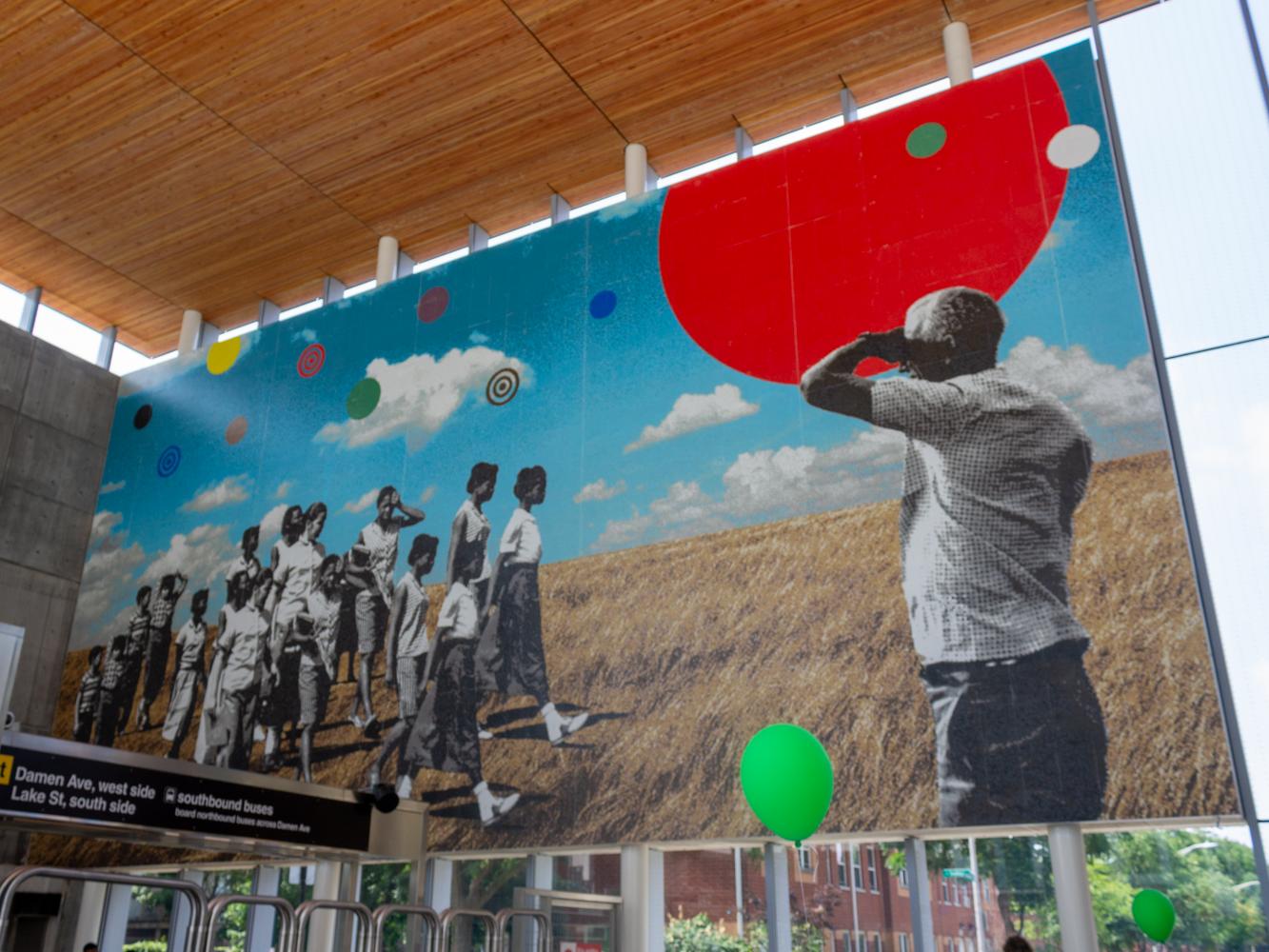
Read highlighted a few examples where Penn State’s non-STEM scholarship is having broad impact, such as a tile mosaic in a Chicago train station by Folayemi Wilson, associate dean for access and equity and professor of art in the College of Arts and Architecture, whose work is seen by thousands of riders each week. In addition, the Colored Conventions Project led by Gabrielle Foreman, Paterno Family Professor of American Literature and professor of African American studies and of history in the College of the Liberal Arts, was cited in the recent birthright citizenship case heard by the U.S. Supreme Court.
Read then introduced three faculty members whose work demonstrates the public impact that Penn State’s non-STEM research has in academia, in industry and across the country
Elizabeth “Cassie” Mansfield, distinguished professor of art history and recently named Guggenheim Fellow, shared research that she conducted with colleagues in Penn State’s College of Information Sciences and Technology that combined art and computer science. The work furthered understanding of art history and helped to advance computer vision research, which in turn can better inform generative artificial intelligence systems, she explained
John Christman, director of the Penn State Humanities Institute and professor of philosophy, of political science and of women’s, gender and sexuality studies, shared the work that humanities scholars are undertaking that are important in their own right but also contribute directly to public discussions of pressing social challenges, including such topics as the ethics and social impact of artificial intelligence (AI). He noted that technological fixes alone cannot address complex problems, and that humanities scholars are providing the ethical, historical and cultural frameworks needed to decide what engineers and scientists should build, how technology should be used and whom it benefits.
Velvet Brown, the David P. Stone Chair and professor of tuba and euphonium, shared how she’s partnering with a global music company to build instruments that are accessible by all players. With colleagues in Penn State’s College of Engineering, she is working to develop lighter-weight tuba cases to lower airline transportation costs and to make them easier to carry. In addition, she recently expanded her outreach program – the High School Recording Experience Series – to engage and inspire young musicians, and which anecdotally has contributed to Penn State’s student recruitment.
Adding to the discussion, Penn State President Neeli Bendapudi noted that the arts, the humanities and the creative process, in general, are critical to understanding the public impact of research
“People are choosing where they live based on the quality of life, and that is so driven by the arts and the humanities,” she said
/Public Release. This material from the originating organization/author(s) might be of the point-in-time nature, and edited for clarity, style and length. Mirage.News does not take institutional positions or sides, and all views, positions, and conclusions expressed herein are solely those of the author(s).View in full here.
