

What can the 38th Church Doctor teach about artificial intelligence? – Catholic Diocese of Wichita
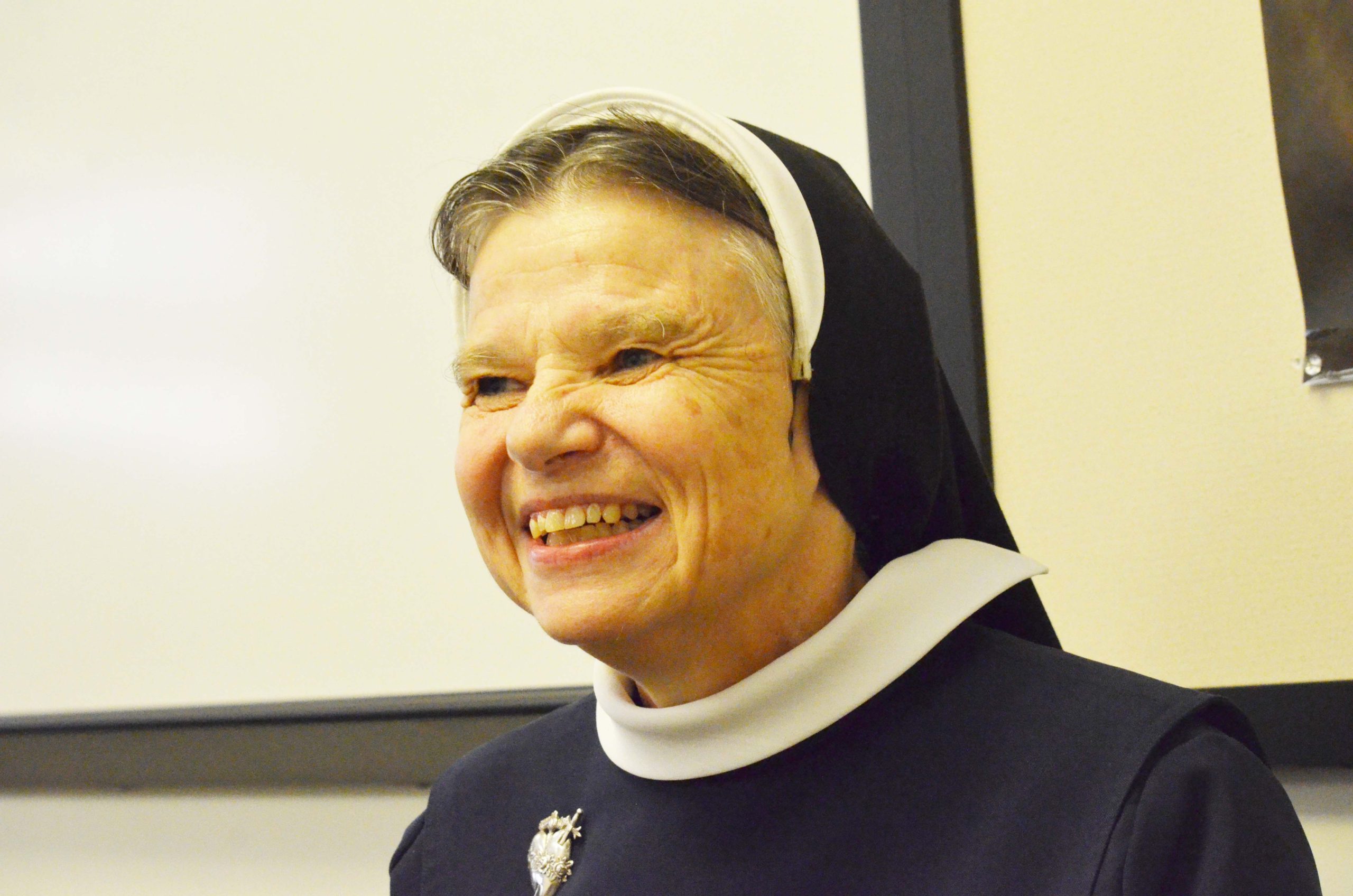
Sr. Mary Catherine Blanding, IHM, the author of the accompanying article, discusses the book from which it has been derived in a June interview with the Catholic Advance. (Advance photos)
What can the 38th Church Doctor teach about artificial intelligence?
July 15, 2026
// Catholic Advance
Editor’s note:This article has been taken from the bookSt. John Henry Newman, the Church’s Newest Doctor, Spiritual Guide to the Catholic Heart,En Route Books and Media, https://enroutebooksandmedia.com/catholicheart
What can a 19th-century saint teach us about artificial intelligence? Much, according to themes found in Pope Leo XIV’s first encyclical, Magnifica Humanitas,and in his recent proclamation of St. John Henry Newman as a Doctor of the Church
We live in a pragmatic technocracy, a society that prizes efficiency, productivity, and usefulness above all else. In such a world, people are often valued only for what they can produce in practical terms. Those who seem less useful are quietly pushed aside. This pragmatic or utilitarian mindset shapes our thinking more than we realize. It weakens our appreciation for relationships, beauty, and faith – realities that do not fit neatly into cost/benefit analyses. Deep commitments look like liabilities. Religion becomes easy to dismiss as escapism.
St. John Henry warned against this distortion. He saw how the modern mind often reduces truth to what is practical or immediately beneficial, overlooking the deeper realities that give life its meaning. Faith, he insisted, is not merely useful; it is true.
However, this truth does not stand in the way of progress. The Church teaches that technology and innovation, when guided by Christian principles, can uphold and even elevate human dignity rather than diminish it. Without a Catholic perspective, we risk being reshaped by the world’s deceptive ideologies. In contrast, figures such as St. John Henry inspire us to engage meaningfully with advanced science and technology rather than letting atheistic worldviews dictate our progress. His vision offers not only intellectual clarity but also a remedy for the spiritual darkness that surrounds us.
Long before our time, St. John Henry prophesied an era marked by practical atheism, a vision that resonates with our current challenges. Canadian Archbishop John Jordan, a notable figure from Vatican II, observed that “the problems he worked on are largely our problems.”
Ryan Topping, contemporary author of books on education and culture, writes: “While it is true that Newman lived before ‘cancel culture,’ before the internet, prior to the Sexual Revolution, prior to both World Wars, the dynamics that gave rise to secularism … were already at work 150 years ago …Steeped in the past, he saw far into the future.”
St. John Henry identified the roots of these issues and provided a supernatural diagnosis. He appealed to the imagination and employed psychological insight to convey his message, standing as both a prophet and a spiritual doctor for our time. The dangerous seeds he warned about have grown into towering trees in parts of our Western world.
When we see our teens changing their sexual identity, when we witness sex trafficking of children or cruelty to the elderly, or when we hear reports of a global war, we may feel overwhelmed. What kind of world will our children, grandchildren, and mentees inherit? These fears are real. However, instead of despair, St. John Henry calls us to respond with conversion – a radical change of heart and mind.
The call to metanoia
The Church’s answer to our condition is simple: repentance, a change of heart. Jesus’s first recorded words in Mark’s Gospel are “Repent, and believe in the gospel.” The popular evangelist Bishop Robert Barron tells us that Jesus’s life builds on this assumption: all is not well with us; we need metanoia, a transformation of vision, attitude, and behavior
However, how do we recognize our need for change? How do we respond to the present darkness, a darkness St. John Henry described as “different in kind from any seen before.” How do we respond to the spiritual challenges of today, which Pope Benedict XVI called “an eclipse of God, a kind of amnesia?”
Pope Francis described our time not as an era of change but as a “change of eras.” Many historians argue that Christendom began to decline in the 1960s, and today its death rattle grows louder. The question is: How will we respond to this unique problem?
This cultural upheaval calls for renewed clarity and courage. Recognizing this, Pope Leo XIV told the College of Cardinals on May 10, 2025, that he chose his name in part to address the new industrial revolution and advances in artificial intelligence, which pose fresh challenges to human dignity, justice, and labor
We can either ignore the crisis or acknowledge and confront it. If we refuse to see the problem, we may be like an alcoholic who blames everything but his addiction. In the same way, if we fail to confront the ideologies surrounding us, we offer false explanations for the way things are rather than facing the truth.
Imagine a man whose drinking has cost him his job, wife, and friends. When asked about his problems, he insists, “It is my boss. It is my wife. It is bad luck.” However, when a true friend brings him to Alcoholics Anonymous, something changes. He finally admits, “The problem is me.” Only then can his healing begin. This is metanoia. It is the realization that the world’s problems are not just “out there.” They begin within us. Like the alcoholic who must renounce his addiction, we must change ourselves before we can hope to change the world. This faith-inspired response is conversion. However, where do we start?
Guide to change
The answer lies in recognizing the need for inner change. St. John Henry’s life illustrates how conversion begins with acknowledging our limitations and being willing to change. He understood that real transformation is not a matter of external circumstances but of an inward revolution. When we look at his life – marked by deep conversions – we see a man continually drawn by truth, no matter the cost. At 15, he turned from agnosticism to Christianity. At 45, he left a life of deep friendships and an esteemed position at Oxford University to enter the Catholic Church. He lived metanoia.
When he became a Catholic, he found heavenly delights, such as relishing Jesus’s real presence in the Eucharist, that he would never give up. However, he lost the love of his family, the comfort of friends, and the Oxford University position he loved. However, he would not turn back because of his faith.
Read and reflect on the following quote:
“We may be full of sorrows; there may be fighting without and fears within; we may be exposed to the frowns, censure, or contempt of men; we may be shunned by them; or, to take the lightest case, we may be (as we certainly shall be) wearied out by the unprofitableness of this world, by its coldness, unfriendliness, distance, and dreariness; we shall need something nearer to us. What is our resource? … It is that holy home which God has given us in his Church; it is that everlasting city in which he has fixed his abode. It is that mount invisible where angels are looking at us with their piercing eyes, and the voices of the dead call us. ‘Greater is he that is in us than he that is in the world.’ [1 John 4:4] ‘If God be for us, who can be against us?’ [Rom. 8:31][9]”
Note the contempt and censure he describes. For some of us, a “cancel culture” may come to mind. Think about the coldness and dreariness some Catholic Christians suffer today from merely being who they are. St. John Henry experienced this firsthand. He knew what it meant to be shunned, misunderstood, and criticized for following his conscience.
However, he also knew that the Church was his true home. When we experience trials, we, like him, can look to the Church as our dwelling place – where saints and angels call us to God’s supreme greatness over anything in this world. St. John Henry can be our mentor – if we let him. His writings are not abstract theological treatises; they are personal and relevant.
Through his Anglican sermons, he conveys foundational Catholic truths, inspiring hope even when every bone in our body cries out in despair. His words remain compelling through time, speaking to how we think, choose, and create.
Again, St. John Henry observed that beneath the surface of modern restlessness lies a spiritual heartache, a heart made for God but estranged from him. He understood that the world’s confusion stems not simply from bad ideas but from something more fundamental: We forget we were made for God. When we overlook this, we not only lose our way – we lose ourselves. This forgetfulness, he believed, is at the root of our confusion.
St. John Henry did not respond with scorn or withdrawal, but with an urgent call to interior renewal. He understood that the battle is not merely external, it is a drama unfolding within each individual, where grace invites us to return to the One who made us. This call to renewal finds its foundation in the Church’s answer to our condition: repentance, a true change of heart. His life, marked by continuous personal conversions, shows the path: beginning with self-awareness, a deep and honest assessment of our hearts, and a readiness to turn toward God.
It is not easy. Like the alcoholic who must first admit, “The problem is me,” we must be willing to face our own flaws. Only then can we begin the true journey of metanoia – personal transformation that leads to a renewed vision of the world. This journey does not happen immediately, and it is painful. However, as St. John Henry’s life reveals, it is in the midst of these internal changes that we find true peace, a peace that surpasses the fleeting satisfactions of the world. Moreover, for those searching for a concrete example of such a path, we need look no further than St. John Henry Newman.
All NewsPrevious
|
Next
