

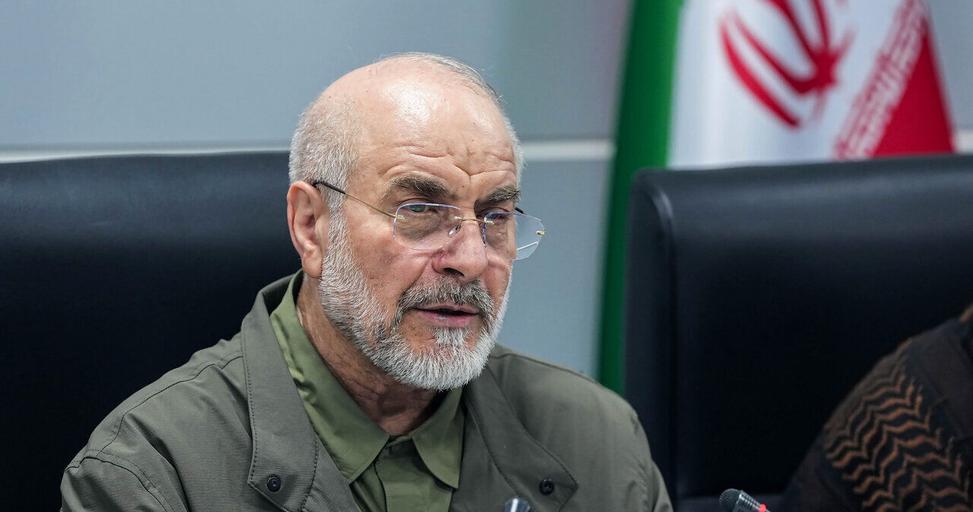
Mohammad Bagher Ghalibaf, the Speaker of the Iranian Parliament, declared in a statement on Wednesday, July 15, that if the Islamic Republic does not benefit from its memorandum of understanding (MoU) with the United States, there is no reason for it to remain committed to the agreement. He also asserted that the US objective is “to overthrow the regime” and “partition the country.”
Stating that “a memorandum only has meaning when its clauses are valid and being implemented,” Ghalibaf said that if the Islamic Republic derives no benefit from the agreement, continuing to abide by it is unjustifiable. Referring to his previous stance, he added: “Based on the eye-for-an-eye policy I have previously stated, we have no reason to remain committed to such an understanding.”
The Speaker of Parliament further remarked, “We are in an essential and existential war with America,” claiming that Washington’s ultimate goal is “to overthrow the regime” and “partition the country.”
Emphasizing that the armed forces of the Islamic Republic “have complete freedom of action, as always, to confront enemy aggression,” he noted that any decision regarding war or negotiations with the United States ultimately rests with the Supreme Leader of the Islamic Republic. According to Ghalibaf, “The line between war and negotiations with the enemy is determined based on security and national interests, and the authority to determine the use of these tools lies with the Guardian Jurist and Commander-in-Chief of the Armed Forces.”
At the same time, Ghalibaf described negotiation as part of the Islamic Republic’s strategy, stating: “War and negotiation are two methods of preserving national interests.” He added that negotiation under the current circumstances “does not mean compromise; rather, alongside war, it is part of the strategy of resistance and safeguarding national interests.”
In another section of his statement, the Speaker referred to the Strait of Hormuz, stating that the Islamic Republic had closed the waterway during the “40-Day War” because its national security had been threatened. He added that maintaining what he termed “Iranian arrangements” in the Strait of Hormuz remains a vital component of the country’s national security
Ghalibaf also claimed that the Islamic Republic’s control over the Strait of Hormuz was established in the fifth clause of the memorandum and had been used as leverage to enforce other terms of the agreement. He accused the United States of attempting to undermine these arrangements through the use of force, concluding that the Islamic Republic must stand firm to enforce the terms of the memorandum and secure what it views as its rights
