

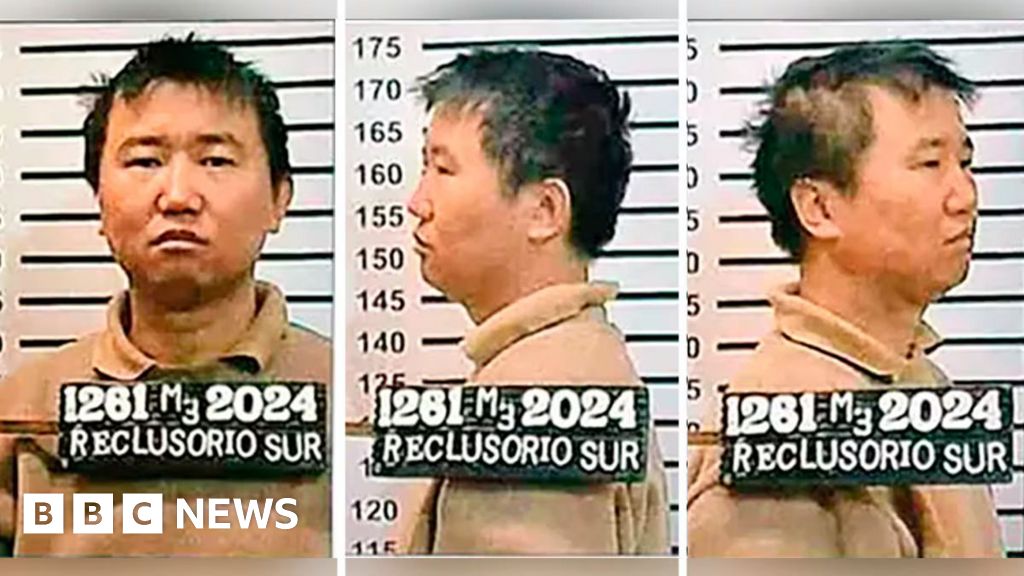
The Chinese graduate accused of being Mexico’s ‘fentanyl king’
8 hours ago

Government of Mexico
“Brother Wang was very important. He was number one,” says Enrique, chuckling knowingly
Enrique – not his real name – describes himself as a high-level co-ordinator in Mexico’s Sinaloa cartel, one of the world’s most powerful criminal organisations
On the outskirts of Sinaloa’s state capital city, Culiacán, sitting in a parked car where no-one can overhear him, he explains how ingredients to make the deadly drug fentanyl are shipped thousands of miles from Chinese factories to laboratories in Mexico. Members of his cartel credit Brother Wang with establishing this supply chain
Known in the criminal world as the “king of fentanyl”, Brother Wang is a 39-year-old Chinese national, whose real name is Zhang Zhidong, according to the US Department of Justice. Arrested in Mexico in 2024, Zhang later made a dramatic escape before he was recaptured and extradited to the US in 2025
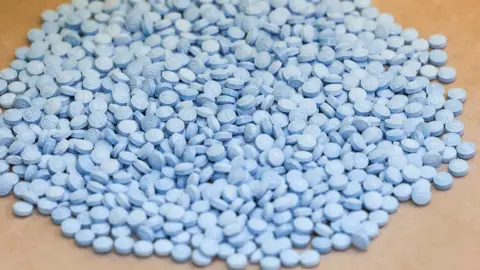
Fentanyl is a synthetic opioid 50 times more potent than heroin. It kills tens of thousands of people each year, mostly in the US, where the finished drug often ends up. A dose as small as a few grains of salt can be lethal
US President Donald Trump has labelled fentanyl dealers “narco-terrorists”, classified the drug and its components as weapons of mass destruction, and used the fentanyl trade as a reason for imposing tariffs on China, Mexico and Canada
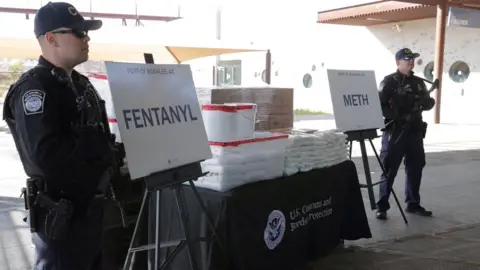
US Customs and Border Protection via Reuters
When Zhang appeared in court in New York in 2025, the Deputy Attorney General at the time, Todd Blanche, described him as one of “the world’s most dangerous traffickers”
He also accused him of “running a global enterprise that pumped massive quantities of cocaine, fentanyl, and methamphetamine” into the US and laundering “millions in narcotics proceeds”
Zhang has pleaded not guilty and is now awaiting trial. We contacted his lawyer, who declined to comment while the case was ongoing
Cartel members and former colleagues agreed to speak to the BBC to give a rare glimpse into how they believe Zhang – a graduate of China’s most prestigious university – allegedly became a key link in the chain between Chinese chemical manufacturers and Mexcian drugs laboratories
Zhang the man
Zhang graduated from the prestigious Peking University in Beijing with a Spanish degree in 2010, and a year later travelled to Mexico to work for a Chinese-owned company that mined iron ore. He soon secured a senior role
Those that knew him at the time saw him as a bright young professional, with an appetite for life abroad
“He was capable of negotiating with people, very relex – not his real name – who studied at the same university and later worked in the same mining company as Zhang in Mexico
He says Zhang spoke excellent Spanish, with an instinct for street language and the ability to talk to anyone – always with a strong Beijing accent
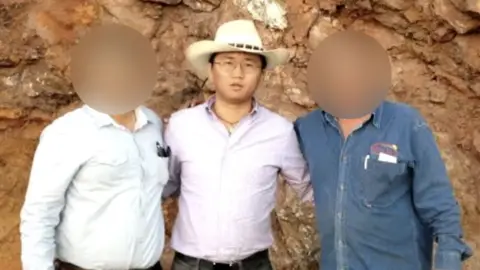
‘Alex’
Alex says doing business in Mexico sometimes involved dealing with the underworld, including the cartels, which control significant areas of the country. Zhang was able to establish relationships with “whoever mattered locally – both the official side and the unofficial side”, Alex says
Zhang loved this aspect of Mexico who paints a picture of a man drawn to risk and recklessness. He recalls him crashing his boss’s car, unconcerned about repercussions, and describes how Zhang drove him out of town one night to shoot pistols at road signs on a deserted highway
In 2013, the mining company collapsed and Alex returned to China but Zhang stayed in Mexico
Alex says that a year or two later Zhang began to post on the Peking University Spanish alumni group on WeChat, offering to change dollars at preferable rates. Alex believes he was laundering money
In addition, cartel member Enrique says Zhang also got involved in drugs. Court filings in the US accuse Zhang of operating “a massive narcotics trafficking and money laundering organization” since June 2016
Enrique believes Zhang got into a romantic relationship with a female relative of one of the cartel’s leaders and suggests this helped him become close to its inner circle
The supply chain
Another cartel member who ran errands for the organisation, Luis – not his real name – recalls a hot afternoon in 2019, when his bosses asked him to stand guard for a meeting where Zhang “came to offer his products”
Luis says these products were the precursors – the chemical building blocks – needed to manufacture fentanyl. He sees Zhang as the person who effectively introduced him to fentanyl and started this side of the group’s business
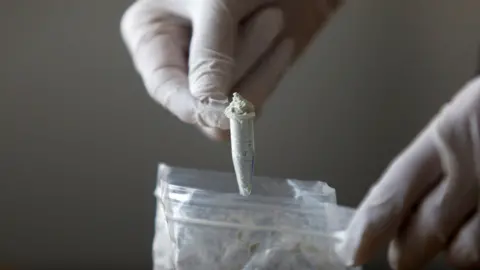
Luis says he soon became a fentanyl cook, making the drug in an clandestine laboratory. He says has seen at least five other cooks die in front of him, and believes this is because the substances they were handling seeped through gaps in their protective clothing
“Sometimes people just pass out, and we have to carry them out of the room,” he says
Reuters / Claudia Daut
Enrique describes how orders for precursors would be placed with Zhang, who he says used his contacts in China to secure the chemicals
The ingredients would then be shipped by air or sea to Mexico He says his own network would then distribute them to fentanyl cooks, such as Luis, in the illicit laboratories in Sinaloa
Pressed on whether he feels guilty for being involved in an industry that causes so many deaths, Enrique says one of his relatives died from a fentanyl overdose. “It shakes your conscience,” he says, but adds, “work is work and we don’t know another way to make a living”
When asked the same question, Luis says he once tried to stop working in the laboratory, but his boss told him the alternative was to go out on patrol. He says his boss gave him a choice: “You put on the vest, the gear, and you go out and fight – it’s either that or working as a cook.”
According to Mexican security agencies, Zhang ran illegal operations spanning the Americas, Europe, China and Japan
Angela Weiss / AFP via Getty Images
Victoria Dittmar, a researcher at InSight Crime, a think tank, has spent years investigating the flow of precursor chemicals into Mexico. She says that brokers – the role it is suggested that Zhang played – sit at the crucial intersection between the chemical producers and the cartels
She says that people with the kind of reach Zhang is said to have had are “quite unique” and “are key to the supply chain”
“He was a broker that connected Mexican trafficking organisations with Chinese suppliers of precursor chemicals,” a world she says it’s hard for outsiders to navigate
“He also had a huge presence in the US,” she says. “You don’t see that often… one person that can connect three regions.”
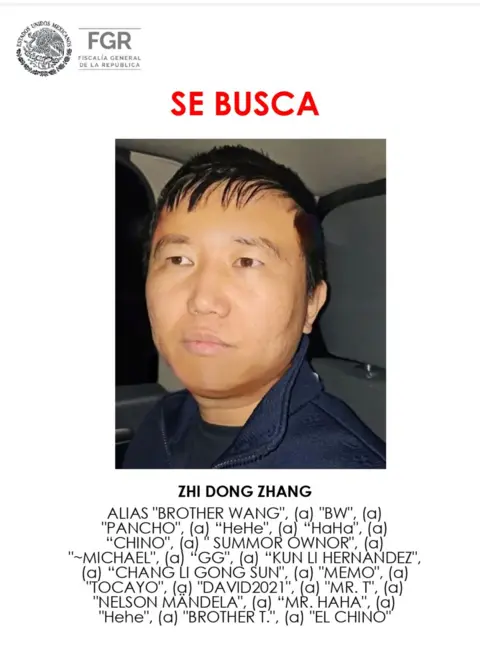
Mexican authorities said Zhang was responsible for exporting and distributing more than 1,000kg of cocaine, 1,800kg of fentanyl and 600kg of methamphetamine. They also accused him of handling more than $150 million in annual drug proceeds
Attorney general’s office, Mexico
The US Department of Justice issued a press release in 2025 with details of the indictment against Zhang. As well as accusing Zhang of drug trafficking, it said he recruited people to open bank accounts on behalf of more than 100 shell companies
It says they would pick up money, at various locations in the US “deposit that money into the shell company bank accounts, and wire the funds to other beneficiary accounts to be laundered outside of the United States”
At the other end of Zhang’s alleged operations sits China. The country is one of the world’s top producers and exporters of the precursor chemicals used to make synthetic drugs, according to a 2025 US State Department report
It says China’s chemical industry is “massive”, with 160,000 companies, and despite steps by authorities to implement controls, oversight is “insufficiently staffed and equipped”
The Chinese embassy in Washington told the BBC that China is “one of the world’s toughest countries on counternarcotics”
It noted that the country scheduled all fentanyl-related substances in 2019, which means they are tightly controlled by the government. They are not banned because some have legitimate uses across multiple industries
The embassy said China’s “extensive and in-depth” counternarcotics co-operation with the US had been “highly productive’
Escape and arrest
Secretary Omar Harfuch of Mexico’s Security and Citizen Protection
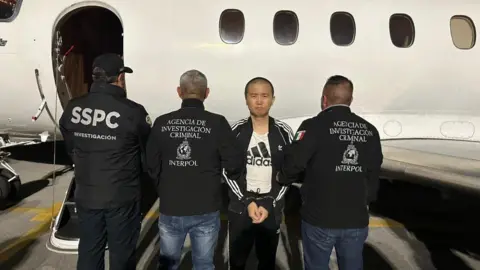
Zhang’s alleged involvement in the drugs trade came to an abrupt end when he was arrested in Mexico on 31 October 2024
A judge took the controversial decision to place him under house arrest, but Zhang managed to slip out – reportedly through a hole in a wall – and flee by private jet to Cuba and then on to Russia
Russian border officials detected his forged papers and he was sent back to Cuba, which returned him to Mexico, from where he was extradited to the United States
His arrest made headlines around the world. The alumni network of Beijing’s Peking University, where Zhang had studied Spanish, was stunned
“Everybody was talking about it,” says Alex. “It was such a shocking story and he’s probably one of the most famous people Peking University produced.”
In Culiacán, the cartel members say Zhang’s absence was felt immediately
Luis says it became “really hard to get the precursors”
“They took the man and that caused a mess,” says Enrique. He says Zhang was “the one with the connections” in China, and the cartels had to “start from scratch and build a new route”
Around the same time, the United States’ Drug Enforcement Administration began to detect a decline in fentanyl purity, which it said was “consistent with indicators that many Mexico-based fentanyl cooks are having difficulty obtaining some key precursor chemicals”
But disruption in drug supply chains is usually temporary, in what Dittmar describes as a “constant game of cat and mouse”
Her research has tracked how, when brokers are removed or key chemicals controlled, fentanyl producers adapt by finding substitutes and learning new processes
Individuals in the supply chain can also be replaced – even, according to the cartel members, ones as deeply and widely connected as Zhang is alleged to have been
Enrique says there is already someone in the frame – another Chinese person, but he says he can’t say more “for my own safety”
Another cartel member, who describes himself as a coordinator responsible for moving goods and personnel within the cartel, says that although “all this started because of him [Brother Wang]… he left lots of connections to help us keep going”
“If he’s gone, someone else will step in… the business will not stop.”
Additional Reporting by Ruth Evans and Miguel Angel Vega
Fentanyl
Drugs trade
Mexico
China
United States
