


Chasing new skills, going back to basics and pushing for collective action: how software engineers are adapting to AI
Software engineering was one of the best-paying professions in the US in 2022, but the advent of AI has disrupted it, leading to several layoffs and underemployment
Every weekday, Matt, a software engineer, looks forward to his four-hour train commute to Pawling, New York. It’s time he uses to work on his own project: a browser-based video game for which he writes every line of code himself
“I am actively trying to keep my axe sharp,” said Matt, who did not want to use his actual name, to protect his employment. In the last six months, Matt’s job has increasingly shifted away from coding, problem solving and software architecture towards reviewing code generated by artificial intelligence. Convinced that the shift will weaken his skills, he’s doing what he can to keep them intact. “I am trying not to leverage AI where I can.”
His career as a software engineer, which typically has paid more than $200,000 annually, used to feel like a sure thing. But after a layoff last summer and a warning from his current boss to use AI more, he said his future feels dark
For a generation of workers like Matt, software engineering promised stability, security and upward mobility. But as AI changes how software is developed – Google says 75% of its code is now written by AI – it’s altering the profession much faster than the rank-and-file anticipated. Software engineers are frustrated, anxious and trying to adapt to a startling new reality in which the value of their skills is unclear. As a result, they’re doubling down on fundamentals, chasing new skills to stay relevant, seeking collective action to push for better protections or even contemplating exiting the industry entirely, according to more than a dozen software engineers who spoke to the Guardian.
Software engineering was one of the biggest and best-paying professions in the US in 2022, with 1.5 million practitioners earning twice the national median salary, according to the US Bureau of Labor Statistics. Pay had risen amid escalating talent wars, during which companies offered bonuses of up to hundreds of thousands of dollars to snag and retain top programmers. Last year, nearly 50 million people worldwide worked as developers, according to market research firm SlashData

But since the release of OpenAI’s ChatGPT in 2022, more than 600,000 US tech workers have lost their jobs, according to tech layoff tracker Layoff.fyi. Meanwhile, the unemployment rate for computer science graduates rose to 7% in 2024, up from 6.1% the previous year, and their underemployment rate was more than 19%, data from the New York Fed shows. US tech job postings on Indeed also dropped 36% from 2020 to 2025
Experts are unsure what’s next for software engineers, but they agree on one thing: coding skills may be losing value, but the ability to evaluate AI-written code is becoming more important
“It’s hard to say what exactly the profession will look like in two years, but it’s clear that the skill of writing code is over,” Bouke Klein Teeselink, assistant professor of economics at King’s College London, told the Guardian. “AI is hugely augmenting what it means to be a software engineer, and the reasonable yardstick” for success depends on how well engineers use the tech
Software engineers still have a job to do, AI has just changed it, said Ethan Mollick, an associate professor of management at the University of Pennsylvania’s Wharton School and author of the upcoming book Co-Existence
“Now it’s not about who can write the most code,” he said. Instead, focus is on defining problems, designing systems and directing AI tools effectively, he said. “It shifts the skills around, so suddenly that’s where the value is.”
Before AI, Matt said he was a “leading voice” in a solution’s execution, but now “the line between what I am deciding and what AI provides has certainly blurred.”
Adapting to the AI-era
Software engineers are grappling with a daunting choice: soldier on in an increasingly unpredictable industry or seek an alternative path
George Dover, a software engineer of six years in Portland, Oregon, became a substitute kindergarten teacher while he searched for new roles after a layoff at Inuit Mailchimp in late 2024
“It’s very difficult to let go of something that was a large part of your personality for a good number of years,” he said. “What else is there for me?”
But Dover didn’t give up. Realizing the need to understand AI, he used AI to generate code to build websites and then evaluated it to learn its strengths and limitations. He checked the code for errors, redundancies, unusual AI decisions, bugs and visual glitches
“The quality has to be rigorously tested,” he said. “Sometimes that tradeoff is a good one, other times it leads you down rabbit holes that take longer than coding it yourself.”

It paid off. Almost two years after being laid off, 400 applications and several interviews later, Dover landed a software engineering job – one oriented towards AI
Dover isn’t the only one experimenting. More non-technical workers are writing code, expanding overall output, which could drive demand for software engineers, said Teeselink. Validating AI-written code requires someone to “find vulnerabilities, understand errors, check security, etc., which non-coders will not be able to do”, he said
But it’s too early to make any definitive declarations about the profession, especially since AI only started generating good quality code last year, said Shriram Krishnamurthi, professor of computer science at Brown University. Still, the growing need for code reviews will likely weed out some professionals, he said
“Some software engineers trained well for this, and many did not,” he said. “Those who did will thrive; those who didn’t are going to have to re-tool.”
Human software engineers will still be needed if for no other reason than the cost of AI, said David Malan, a Harvard University computer science professor. In their race to build and run models, OpenAI reportedly spent $8bn and Anthropic is expected to have burnt $3bn last year, according to Reuters. Costs are widely expected to eventually pass on to customers. So rather than companies relying entirely on the tech, Malan expects to see a “healthier balance of software engineers being supported by AI”.
The highs and lows of coding
More than a decade ago, the push to code came from every direction
In December 2013, President Barack Obama launched a $4bn initiative called Computer Science for All to teach computer science to all American students, calling it the “new basic” skill for economic opportunity. The private sector echoed a similar message, with Mark Zuckerberg and Bill Gates participating in coding tutorial videos for educational non-profit CodeAI. The same year, coding bootcamps exploded, producing more than 2,000 graduates, which rose more than 1000% by 2020, according to coding bootcamp tracking organization Course Report.
“Learn to code” became a mantra for building a successful career
That’s why Los Angeles resident Sam, who asked for anonymity to protect his employment, pivoted to software engineering a decade ago. After dropping out of school for a music degree, racking up $130,000 in student loans, and taking a stab at some odd jobs, he pursued a software engineering degree

But in his first five years on the job, he’s gone from feeling professionally stable to fearing he could lose it all. He hates that AI has taken over “the creative, fun part of the job”, and reduced it down to the worst part: “reviewing code I didn’t write”, said Sam
He’s worried about the future, fearing a layoff would end his career by forcing him to compete with displaced talent from Google, Amazon and Netflix, he said
“I’m thinking as I sit in my office, ‘What if I opened a food truck? What if I got into forestry?,’” he added
Sam isn’t alone in his malaise. More than a decade after the coding push, the buzz for the profession is fading. Enrollment in computer and information science programs at four-year universities fell 8.1% and graduate enrollment dropped 14%in the 2025-2026 school year, according to the National Student Clearinghouse, a non-profit that tracks educational institutions
Tech workers unite in their plight
As AI threatens their livelihoods, software engineers are increasingly organizing and banding together
For Kaitlin Cort, watching AI reshape her role led her to quit and start a re
“I’m not a very senior-level engineer,” she said. “I can see that the pace at which AI was getting better was faster than the pace at which I was getting better. That definitely made me really anxious.”
Cort originally became a software engineer to pay off student loan debt. She also taught at coding bootcamps, where students from low-income backgrounds and domestic violence shelters showed her firsthand what coding could do for people’s lives. But once her job shifted from writing code to reviewing what AI generated, she began to rethink her career and where she might make a greater impact
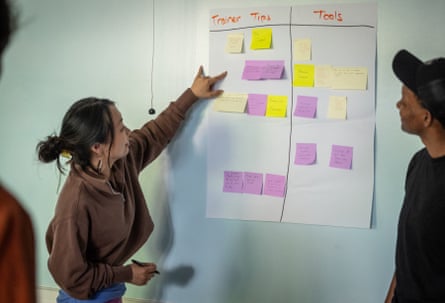
In February, Cort started What We Will, which helps tech workers navigate layoffs and negotiations, access basic income in unemployment, upskill and organize unions. The center’s inaugural campaign, launched in its first month, aimed to help Amazon workers organize against rapid AI adoption and guide laid off workers through their benefits. Its second campaign targeted workers cut from Oracle, aiding them with severance negotiation and creating support groups. In May, it worked with Meta workers to discuss employee surveillance.
Worries about AI and mass layoffs are driving membership and interest in collective action, Cort said. She receives at least 10 new applications each day, and “in the last few months, so many more people [are] specifically reaching out looking for unionization”, she said
But she’s largely building without a roadmap since few in the industry have done this before. As a result, she’s turned to Alphabet Workers Union and the Washington Post Tech Guild, among others, for guidance
“There’s a lot of need right now,” she said. “We just, as an industry, don’t have a guild – we don’t have regulations or standards that are really shared.”
