

Cornstarch can thicken your egg drop soup or serve as a base for a DIY shampoo, but there’s more to the humble pantry staple. Given the right conditions, it seems to defy the laws of physics
Mixing cornstarch with water creates oobleck — a shape-shifting substance classified as a non-Newtonian fluid that changes states when subjected to a force. Leave it alone, and it oozes like liquid. Stir it up, and it gets more viscous before locking into a solid. Under certain conditions, if it’s punctured, it can even fracture The thickening phenomenon is known as the oobleck effect
Back in 1949, Dr. Seuss made oobleck famous as the “green goo” wreaking havoc on a fictional kingdom that a boy named Bartholomew endeavors to rescue. But today, Northeastern mechanical and industrial engineering scientist Xiaoyu Tang and Ph.D. student Boqian Yan are using the same mix of ingredients for a different purpose.
After receiving the 2025 NSF Career Award grant last year, they set out to take a deep dive into the behavior of water droplets containing solid bits of cornstarch. The results, published in Physical Review Fluids this June, have implications for 3D printing, the environment, and more
Non-Newtonian materials, like oobleck, have many practical uses. According to Nanografi, a global nanotechnology company, they’re used to make printer inks, brake fluids and noise reduction dampers for washing machines. They’re also the secret behind the Mous AiroFoam phone case, famous for viral ad campaigns featuring pricey devices surviving air balloon drops intact thanks to a hardening response similar to the oobleck effect
However, there are lots of gaps in the knowledge of how non-Newtonian droplets that contain particles behave, especially when they collide with liquids.
To shed light on the matter, they used a syringe pump to launch droplets containing different concentrations of cornstarch into a pool of water at various impact velocities, the speed and direction of an object at the moment it hits a surface.
“We have this dropping system, and then we have this pool, and then we have the imaging process with the high-speed camera that works at 15,000 frames per second,” Tang explained.
They captured each moment down to the tiniest detail with high-speed cameras.
Half a year and dozens of trials later, they have some answers
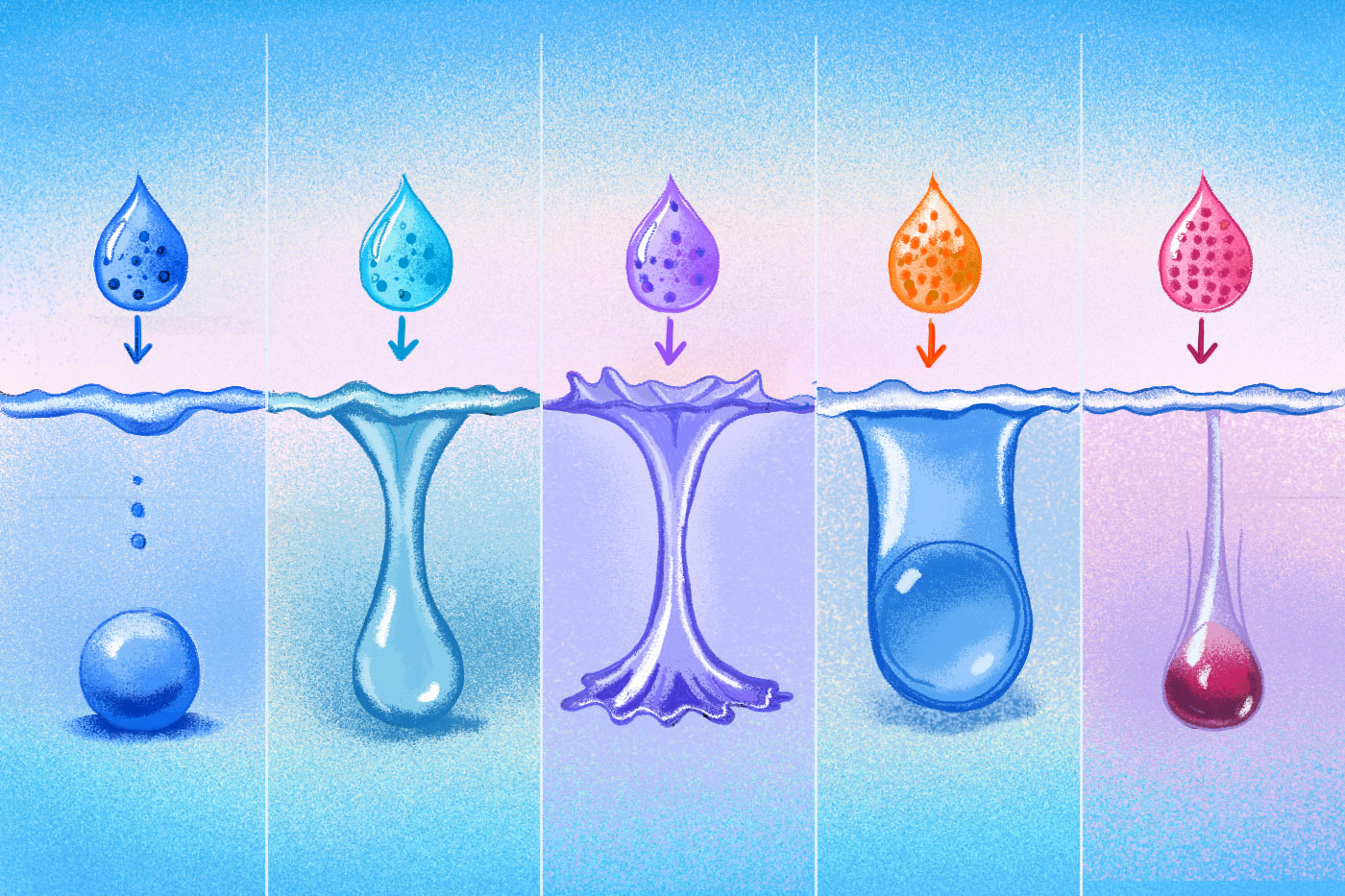
Tang and Yan observed a tug-of-war between two processes: the water in the pool forming a crater to suck the droplet in and pull it apart, and the particles within the droplet keeping it together as they responded to forces causing it to thicken at varying rates. They grouped the droplets into five distinct types – ranging from least to most solidified.
The lowest starch concentration and impact velocity levels resulted in the formation of the so-called liquid lump. This type of droplet slipped underwater as a distinct blob, but behaved more or less like a Newtonian fluid, the researchers explained.
Two droplet types with slightly higher impact velocities both prompted the formation of a cavity when they made impact with the water, but the droplets interacted with it in different ways. Partially attached droplets still looked like lumps at the bottom but spread out into the cavity at the top, Yan said. Fully attached droplets with slightly higher velocities completely dispersed into the cavity, which expanded to make room for them.
Droplets with higher particle concentrations made up the fourth group — wrapped bubbles. The cavity that formed in the water trapped them inside, causing their particles to fold inward and create hollow spheres.
The most concentrated droplets, solid lumps, remained perfectly spherical and “sank down as a solid ball,” Tang said. The oobleck effect was strongest among them, and they would harden in response to a slight disturbance
Getting solid lump droplets to form intentionally means “you can make a perfect sphere,” which is very hard to do, Tang said. They’re the holy grail in drug manufacturing, as spherical micropellets allow for accurate dosage, according to pharmaceutical industry experts
Moreover, Tang thinks the results could make 3D printing more precise. The lab is planning to run additional tests to find out more
3D printing and additive manufacturing consultant Joris Peels confirmed that fluid dynamics research has played a major role in the evolution of printing. On the “3D Printing News Unpeeled” podcast, Peels delights viewers with the latest printed creations — anything from hearing aids and pickle balls to mailbox keys, bridges, and space rocket engines
There are environmental implications as well.
Tang explained that certain pesticides spray non-Newtonian droplets, which end up on soil and leaves around them. If those particular droplets spread across the surface of the plants, it means the chemicals are being absorbed more efficiently and do not need to be overused. Likewise, raindrops can act as non-Newtonian droplets that can form bubbles in pools or deposit oxygen into bodies of water in ways that could affect these habitats, she said.
Tang says her team’s paper “lays out the groundwork for the next series,” which will examine individual types of droplet behavior in more detail.
“It gives us a map,” she said
