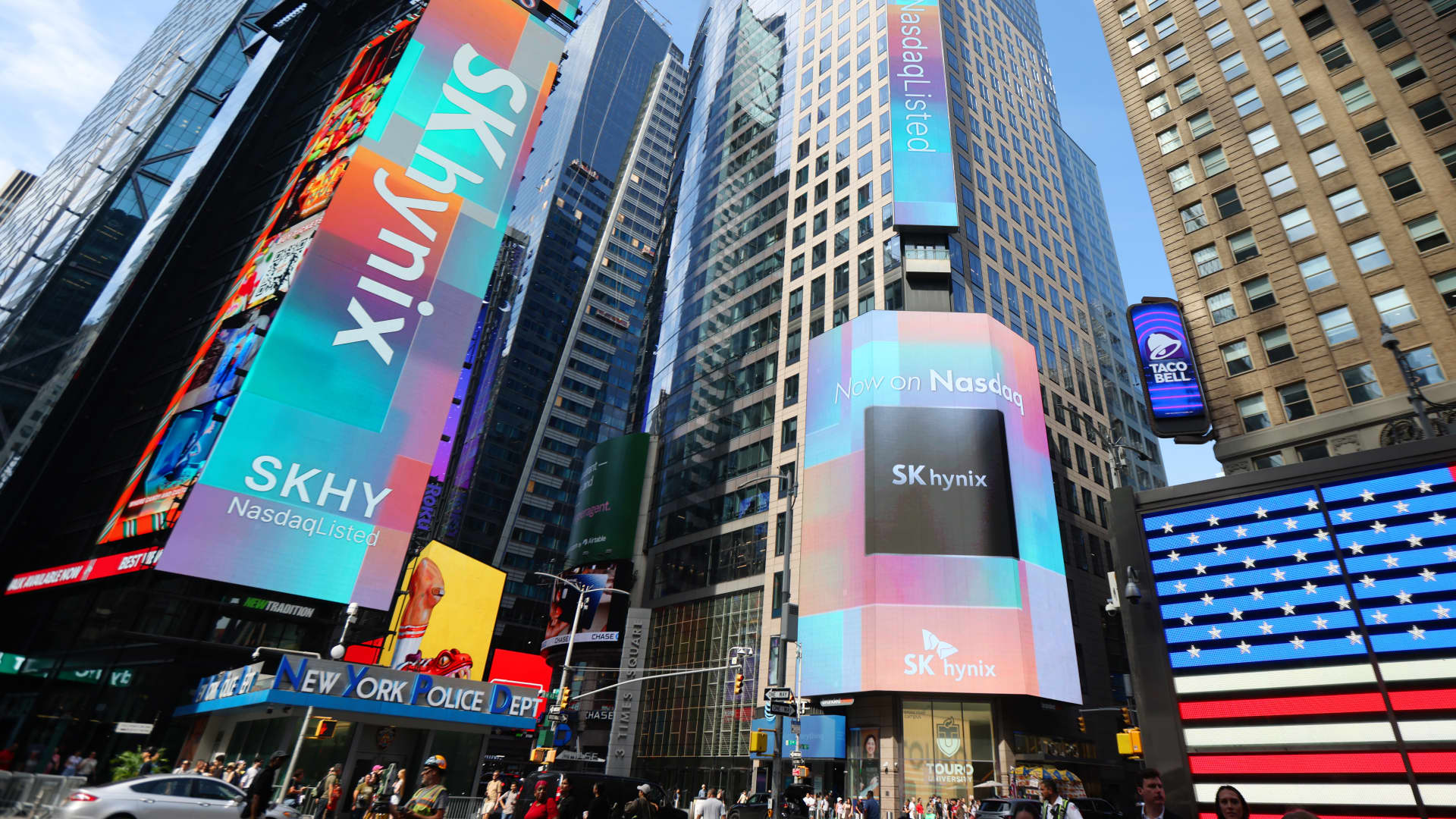
- SK Hynix, South Korea’s second-most valuable company, started trading on the Nasdaq on Friday.
- The memory maker’s American depositary receipts, or ADRs, are available to U.S. investors.
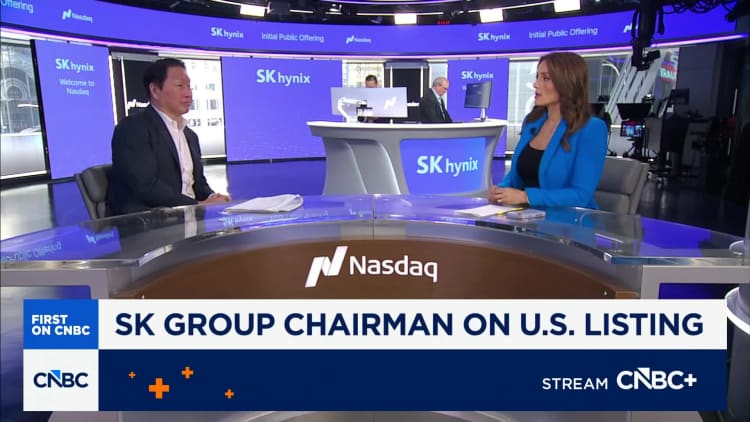
- Chairman Chey Tae-won told CNBC that AI agents and robots need “a lot of memory chips.”
watch now
SK Hynix rose 13% in its first day of trading on Nasdaq, closing at $168.01, as U.S. investors jumped at the opportunity to get a stake in South Korea’s second-most valuable company
The stock is trading under the ticker symbol SKHYV, and will switch to SKHY as of Tuesday. The stock opened at $170 and drifted lower in Friday’s trading session
The company’s American depositary receipts, or ADRs, were priced at $149, raising $26.5 billion for its aggressive expansion plans, which includes investing in new factories and equipment
“It’s a kind of dream, and now it’s a dream come true,” SK Hynix Chairman Chey Tae-won told CNBC’s Kristina Partsinevelos on Friday
SK Hynix trails only Samsung by market cap in its home country. Like its larger rival, the company makes computer memory, which is used by phones and PCs to store short-term data. SK Hynix’s roster of customers includes some of the biggest names in technology, such as Nvidia and Apple
Memory, for decades, was tucked in a sleepy corner of the semiconductor world, but the artificial intelligence boom has turned it into a massive growth market
Tae-won told CNBC that when he meets with customers and partners, everybody expects more chips. He said that even when SK Hynix announced it would double capacity within five years, customers said they still need more
“All my customers said that, ‘Well, that’s not enough, man, and, well, we need more,'” Tae-won said Friday
SK Hynix’s valuation has risen more than sevenfold over the past year as demand for AI infrastructure has caused a shortage in computer memory and sent prices skyrocketing
SK Hynix is the leader in the high-performance memory that’s used in AI chips from Nvidia, the world’s most valuable company. Compared with RAM for phones or laptops, AI chips require high bandwidth memory, or HBM, which is created through a complex process that involves stacking many layers of traditional memory together
“The demand is enormous, exponentially, so I don’t really see” signs that HBM demand is shrinking, Tae-won said
Betting on memory booms has proven risky due to the cyclical nature of the business. Big tech shifts like the dot-com frenzy, the growth of smartphones, or the transition from packaged software to the cloud have brought huge demand for memory to power new devices. That’s often led to oversupply, followed by a collapse in prices
The concern is pervasive today given the hypergrowth of AI. But Tae-won said SK Hynix is confident that demand for memory has permanently changed from past boom-bust cycles
“The AI agent, physical AI robot, actually that needs a lot of memory chips,” Tae-won said
Some of that HBM will be packaged in the U.S. after the company announced a $4 billion advanced packaging plant in Indiana. But the vast majority of SK Hynix’s planned expansion over the coming years will take place in South Korea. That includes a cluster of chip fabrication plants in Yongin that will cost $390 billion
SK Hynix’s listing comes about a month after Elon Musk’sSpaceX went public in the largest initial public offering on record